Service
Basement Wall Repair in Scranton, PA
Basement wall repair in Scranton, PA uses carbon fiber straps, steel wall anchors, and crack sealing, matched to how far the wall has moved. A basement wall that bows inward or cracks is reacting to soil and water pressure from outside, and in Scranton's older foundations that pressure builds every wet spring and every freeze-thaw winter. Call 272-207-1992 to be connected with a local provider.
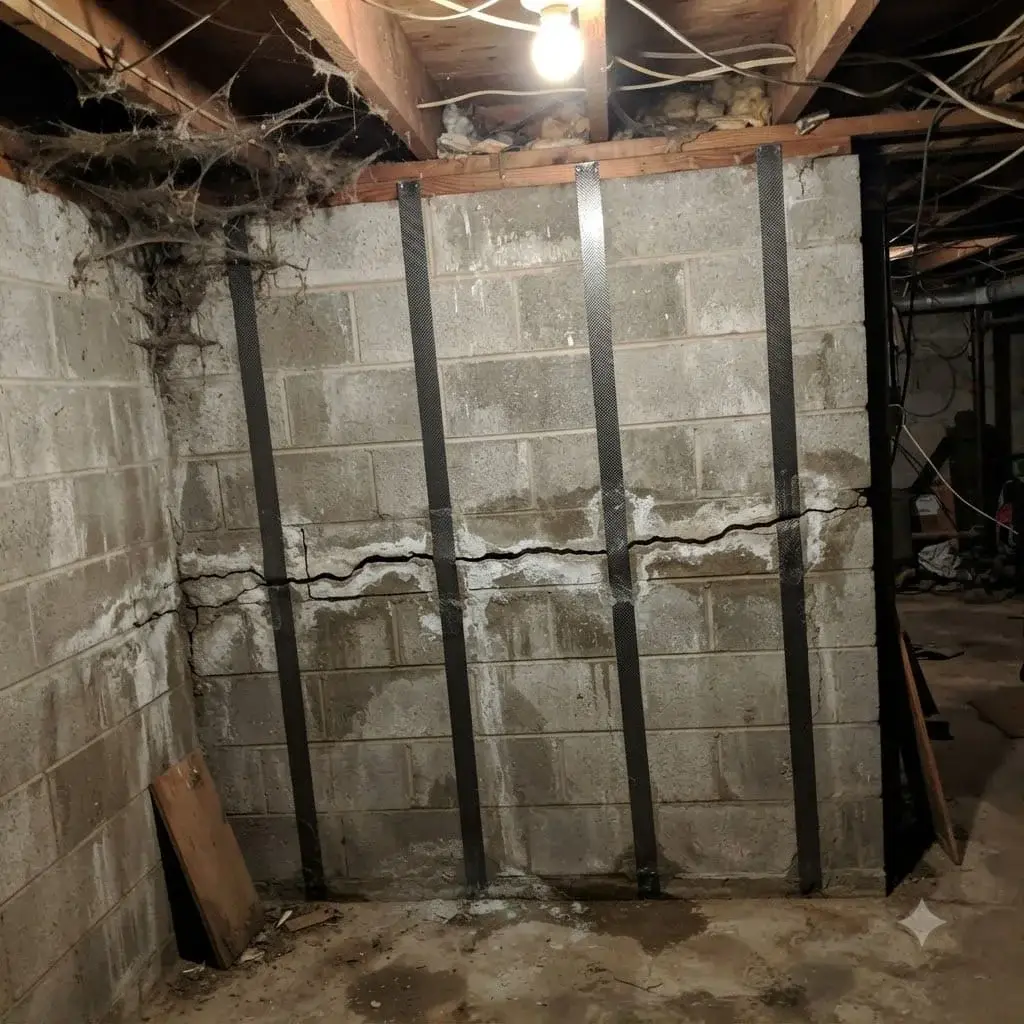
A moving wall is a structural problem, not just a water problem. Soil swells when it's saturated and presses against the foundation, and when the ground freezes and thaws it heaves and shifts against the wall again and again. Over time a block or stone wall answers that pressure by bowing in, cracking horizontally, or leaning at the top. The fix stabilizes the wall and, where it's needed, pairs the repair with waterproofing so the water driving the movement gets handled too.
Signs Your Basement Wall Needs Repair
Basement wall damage shows itself in a handful of clear signs. A horizontal crack running along the middle of a block wall is the classic warning, since it marks where the wall is bending under pressure. Other signs include a wall that bulges or bows inward, a wall that leans at the top where it meets the joists, stair-step cracks along the mortar joints of a block wall, and a wall that has started to slide in at the bottom. Any of these means the wall is losing its fight with the soil, and the sooner it's addressed, the less it moves.
How Bowing and Cracked Walls Get Repaired
Wall repair in a Scranton basement comes down to matching the method to the amount of movement. There are three main approaches, depending on how far the wall has gone.
Carbon fiber straps suit walls with minor to moderate bowing, generally a wall that has moved less than about two inches and isn't actively sliding. Vertical lines on the wall are ground and cleaned, then high-strength carbon fiber straps are bonded from the floor to the sill with structural epoxy. The straps lock the wall in place and stop further inward movement, and they sit nearly flush so the wall can still be finished.
Steel wall anchors suit walls that have bowed further or are still moving. Anchors connect the basement wall through a rod to a steel plate set in the soil out in the yard, and tightening them holds the wall and can, over time, recover some of the movement. Anchors need yard access on the outside, which gets checked during the inspection.
Crack sealing and injection handles cracks that are letting water in but aren't a structural threat on their own. The crack is injected with a resin that fills it through the full thickness of the wall. On its own, crack sealing stops a leak, but when a crack is a symptom of a bowing wall, the movement needs addressing too, not just the gap.
Why Scranton Walls Move
Scranton's foundations move for reasons specific to the valley. More than half the city's homes were built before 1940, and their stone and early block walls were never engineered for modern soil loads. The channery silt loam around them holds water unevenly and swells when saturated, pressing on the wall. Then winter drives the freeze-thaw cycle: water in the soil and in the mortar joints freezes, expands, and shifts the wall, and repeats that dozens of times a season. A wall that looked fine five winters ago can show a horizontal crack today. Where a home also sits over old mine workings, settlement from subsidence can add its own movement, which is a separate issue worth checking on the Pennsylvania DEP map.
What to Look for in a Provider
- Local to Scranton. Look for a provider who reads the valley's older walls and the freeze-thaw and soil pressure behind their movement.
- Registered and insured. Pennsylvania requires most home improvement contractors to register with the state Attorney General, so ask for the registration number and a current certificate of insurance.
- A written scope before the work. Ask for the measured movement and the proposed method in writing before anything is committed to.
- Scheduled appointments — not an open-ended window. A provider who commits to a time and keeps it is a good sign.
- The right-sized fix. Carbon fiber, anchors, or injection should match the actual movement, paired with waterproofing only when the water calls for it.
Work is performed by independent professionals, and Scranton requires a building permit for structural wall repair of this kind.
Frequently Asked Questions
Is a horizontal crack in my basement wall serious?
A horizontal crack in a block basement wall is the most serious crack pattern, because it marks where the wall is bending inward under soil pressure. Unlike a thin vertical crack, which is often just shrinkage, a horizontal crack means the wall is losing its fight with the ground outside. It won't recover on its own and tends to worsen each wet season and each freeze-thaw winter. It should be assessed before the wall bows further.
Carbon fiber or wall anchors — which does my wall need?
Carbon fiber straps suit walls with minor to moderate bowing, generally under about two inches of movement, that aren't actively sliding. Steel wall anchors suit walls that have bowed further or are still moving, and they can recover some movement over time because they're tightened from a plate in the yard. Carbon fiber needs no outside access; anchors do. The amount of movement decides it, which is what the inspection measures.
Can a bowing wall be fixed without rebuilding it?
A bowing wall can almost always be stabilized without rebuilding, as long as it's addressed before it moves too far. Carbon fiber straps or steel wall anchors hold the wall and stop further movement, and anchors can pull a wall back over time. Full rebuilding is a last resort for walls that have failed structurally. Catching the problem at the first horizontal crack is what keeps it a stabilization job rather than a rebuild.
Does fixing the wall stop the water too?
Fixing the wall stops the movement, but water needs its own fix. Carbon fiber and anchors stabilize the structure; they don't drain the water that's pressing on it. Crack injection stops a specific leak. When a wall is both moving and leaking, the usual approach is to stabilize it and add waterproofing, usually interior drainage, so the pressure driving the movement is relieved. Handling only one side of the problem leaves the other to come back.
Could mine subsidence be moving my wall?
Mine subsidence can move a foundation, and it's worth ruling out in Scranton because much of Lackawanna County sits over old coal workings. Subsidence shows up as settlement or sinking rather than the inward bowing that soil pressure causes, but both appear as cracks in the same old walls. The Pennsylvania DEP maps the at-risk areas, and standard homeowners insurance usually excludes subsidence damage. If your home is in a mapped area, call 272-207-1992 to reach a local provider who can walk through what applies.
Call Now
For basement wall repair in Scranton, call 272-207-1992 to be connected with a local provider. See the full service area, or learn about interior drainage and sump pumps and exterior basement waterproofing.